If you’ve ever asked me what I do and walked away more confused than before, this article is for you. The short answer is that I am an aerospace PhD student at Texas A&M who researches laser diagnostics for hypersonics and plasmas. Most people don’t really understand what this means and the conversation conveniently moves forward. I’ll cover what it’s actually like to be a PhD student, go over some scientific concepts, and then get into the specifics of what I do.
PhD Life
What a PhD looks like varies a lot from person to person, so I’ll speak from my own experience. When I got accepted to my PhD program, it was a process halfway between applying to undergrad and getting hired for a job. Your potential advisor will interview you and if everything goes well, they will be responsible for guiding you through the PhD. As part of accepting a funded offer, you receive a stipend (currently $2500/month) and have your classes and healthcare paid for. There are three major milestones in a PhD. The first is the Qualifying Exam, which is a set of 3 consecutive days of wonderful 3-hour, written tests. The second is the Preliminary Exam, where I presented my research to my committee. The third and final milestone is the Thesis Defense, a formal presentation of your completed research that is accompanied by the submission of a written dissertation.
During the first couple years of your PhD, it’s typical to take 1-3 classes per semester. Later on, you transition to fully doing research which is what I do right now. As a 4th year PhD student, I mostly work on research at the lab (ALLEMO is located off the primary campus over by the airport in College Station). I have a couple meetings every week and will occasionally leave for a week to attend a conference. As a grad student, you don’t get the same breaks that all the undergrads get. Unless you have an internship, the summers are also a time to focus on getting productive research done without the distraction of classes. Almost every project requires collaboration and there are so many amazing people that I get to work with. However, I will leave people’s names out of this article because they didn’t sign up to be on a random blog.
Physics
Before getting into the details, here is some quick background. A laser is a beam of light that is unique because all of its light waves are the same wavelength and are perfectly synchronized (unlike the scattered, mixed wavelengths coming from something like a light bulb). A femtosecond (fs) is one quadrillionth of a second and a picosecond (ps) is one trillionth of a second. When I refer to a 1 kHz or 60 kHz laser system, that means the laser is firing 1,000 or 60,000 times per second respectively.
Laser diagnostics are essentially a group of techniques that apply a laser to perform a measurement. It sometimes feels like the general public believes that you can just point a laser at an object and then just starts shooting out information. It’s obviously a lot more complicated than that and there are many different laser diagnostics that are suited for various purposes. Some things to consider when choosing your diagnostic are:
- What you are trying to measure (velocity, temperature, density, electric field, etc.)
- What you are measuring it in (plasma, gas, liquid, or solid, and the chemical composition of that material)
- Spatial resolution requirements (where is your measurement region, how many dimensions does it cover, and how many points in space do you need?)
- Temporal resolution requirements (how many measurements do you need and how quickly do you need them)
Depending on your specific situation, one diagnostic might be a perfect fit and another might be completely useless.
Plasma is the 4th state of matter and consists of 99% of all matter in the universe (Solids, Liquids, and Gasses are actually pretty uncommon). Plasma is essentially a gas with so much energy that electrons are free to move from one molecule to another. In high tech fields like semiconductor and fusion, some of the very hardest physics problems to solve involve using plasmas. Increasingly, plasma processes are also heavily used in many more industries such as medical devices, chemical processing, packaging, or consumer goods. Even simple plastic water bottles often use plasma-enhanced chemical vapor deposition to coat the inside with an additional film.
Hypersonics is a term for anything that is traveling through our atmosphere at a speed greater than Mach 5. If you’re unfamiliar with the Mach term, it is equivalent to the speed of sound (~ 770 mph at sea level). Your typical commercial passenger plane cruises at around Mach 0.8 which means hypersonic speeds are more than 6 times faster than that. This field is interesting to NASA because everything that comes from space down to earth is hypersonic at some point. It is also interesting to the US military because… weapons.
Thermal non-equilibrium is when you have different levels of energy between the different modes of a molecule. Let’s step back a bit. A molecule (such as the N2 or O2 in air) is constantly vibrating, rotating, and translating. Each of these modes carries a certain amount of energy and the Boltzmann distribution gives us a way to convert those energy levels into a temperature. In normal conditions, the energy states between these different modes is the same. This is true in ambient air, a flame, and most other environments humans commonly interact with. For example, if the rotational temperature in a regular flame is 800 K, then the vibrational temperature would also be 800 K. However, this is not true for some environments like plasmas and hypersonics. In these exotic environments, you might have a rotational temperature of 800 K, but the vibrational temperature could be 5000+ K! This is really significant because it affects the chemistry of those molecules and the heating of other, interacting materials in the system.
Coherent Anti-Stokes Raman Scattering (CARS) is the primary laser diagnostic that I use for my research. This is a tool that allows for relatively non-intrusive measurement of molecular energy states. An intrusive measurement is something that affects what is being measured. If you wanted to measure a hypersonic flow but had to stick a thermocouple in the middle of it to measure temperature, then this would be highly intrusive because it is disturbing the flow. I describe CARS as relatively non-intrusive because although we are using lasers to make a measurement at a distance, there is still a small amount of energy deposited into the flow that can normally be neglected.
CARS is a laser diagnostic that can be implemented multiple ways. For simplicity, I will only describe the variant that I commonly work with which is known as hybrid fs/ps ro-vibrational CARS. This technique requires three beams: a fs pump and Stokes beam which produce a broadband coherence. Think of the pump and Stokes beams as setting the rudders and sails of an entire fleet of sailboats to exactly the same orientation. They work together to phase synchronize all of the molecules in the measurement volume at once. The ps probe beam is then the wind that arrives at a controlled delay. Because all of the molecules are aligned, the wind drives them all in the same direction rather than leaving them randomly jumbled, producing a strong, directional signal that carries information about the molecular energy states. The produced signal is a spectrum whose shape contains the vibrational and rotational energy distribution of the molecules being probed, which maps to temperature.
Hardware – I’ve built two CARS systems at different laser repetition rates. For the 1 kHz system, I designed a compact box that attaches to the end of the laser and is used to align the three beams both spatially and temporally. Inside the box is a system of mirrors mounted on translation stages. Since lasers travel at the speed of light, adding just 1 mm of path length to a beam delays it by about 3.3 ps, which allows control over the relative timing between beams. Dichroic mirrors, which transmit light at one wavelength and reflect at another, are used to combine the beams and make them collinear so they all overlap at the measurement location.
For the 60 kHz system, the probe and Stokes arms required significantly more delay than could fit inside a compact box, so the system was built directly on the laser table. The key tradeoff with this system comes down to pulse energy. A 5 W laser running at 1 kHz delivers much more energy per pulse than a 4 W laser running at 60 kHz, which means less CARS signal is generated from a single pulse. However, the higher repetition rate means more measurements per second, and the lower peak energy deposited into the measured molecules makes this system less intrusive overall.
Simulation – Building the hardware is only half of the problem, because in order to extract temperature from the raw data, we also need to simulate what the CARS signal should look like. I write scripts (in either MATLAB or Python) to simulate CARS. The script will calculate all of the vibrational and rotational levels for a molecule using a database of known parameters. Afterwards, the Modified Exponential Gap (MEG) model is used to get the molecular response of the simulated molecule at that specific vibrational and rotational energy level. This molecular response is combined (we perform a convolution) with the parameters of the three CARS beams. The calculations are performed in the frequency domain and then a Fourier transform is used to extract the results in the time domain. It’s critical to simulate hybrid fs/ps CARS in time because the spectrum can shift significantly based on small changes in the relative timing between the three beams. Ultimately the goal is to produce a large library of synthetic (or simulated) CARS spectra that matches your experimental conditions.
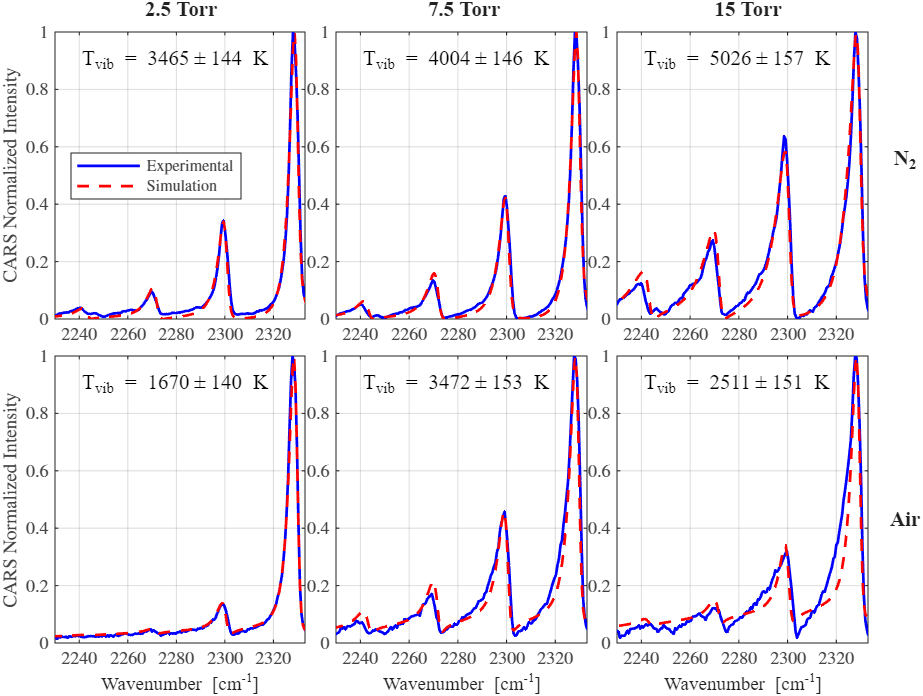
These simulations are crucial because the raw CARS data that is produced is an experimental spectrum (picture squiggly lines). In order to actually extract a temperature from the experimental data, you need to compare your data to your library of synthetic CARS spectra. This library will have a synthetic spectrum for each temperature (and some other variables that are too nuanced to talk about here). Essentially, we find whichever synthetic spectrum looks the most like our experiment and its temperature is assigned to that experimental measurement.
I’ve also been working on a variation of rotational thermometry using CARS, but that work isn’t published yet so I can’t talk about it.
CARS and FLEET Measurements in Hypersonics
My work only intersects with hypersonics through wind tunnels which are ground test facilities that can generate hypersonic flows. I don’t actually test any specific vehicles or designs, I work on developing the tools to non-intrusively measure these flows. My work in this area has either taken place in HXT (Hypervelocity eXpansion Tunnel) or BLAM (Bench-top Ludwieg tube for Aerodynamic Measurement). HXT is a large wind tunnel that operates in the range of Mach 5-Mach 20 with a very short test time. BLAM is much smaller, not truly hypersonic (Mach 4) but the test times are hundreds of times longer than HXT (~400 ms). BLAM is fairly easy to operate alone, and you can run it a dozen+ times a day. Throughout the HXT campaigns that I’ve led, It usually requires coordinating 5+ people in order to get a single run per day. Huge thanks to everyone that helps with those projects.
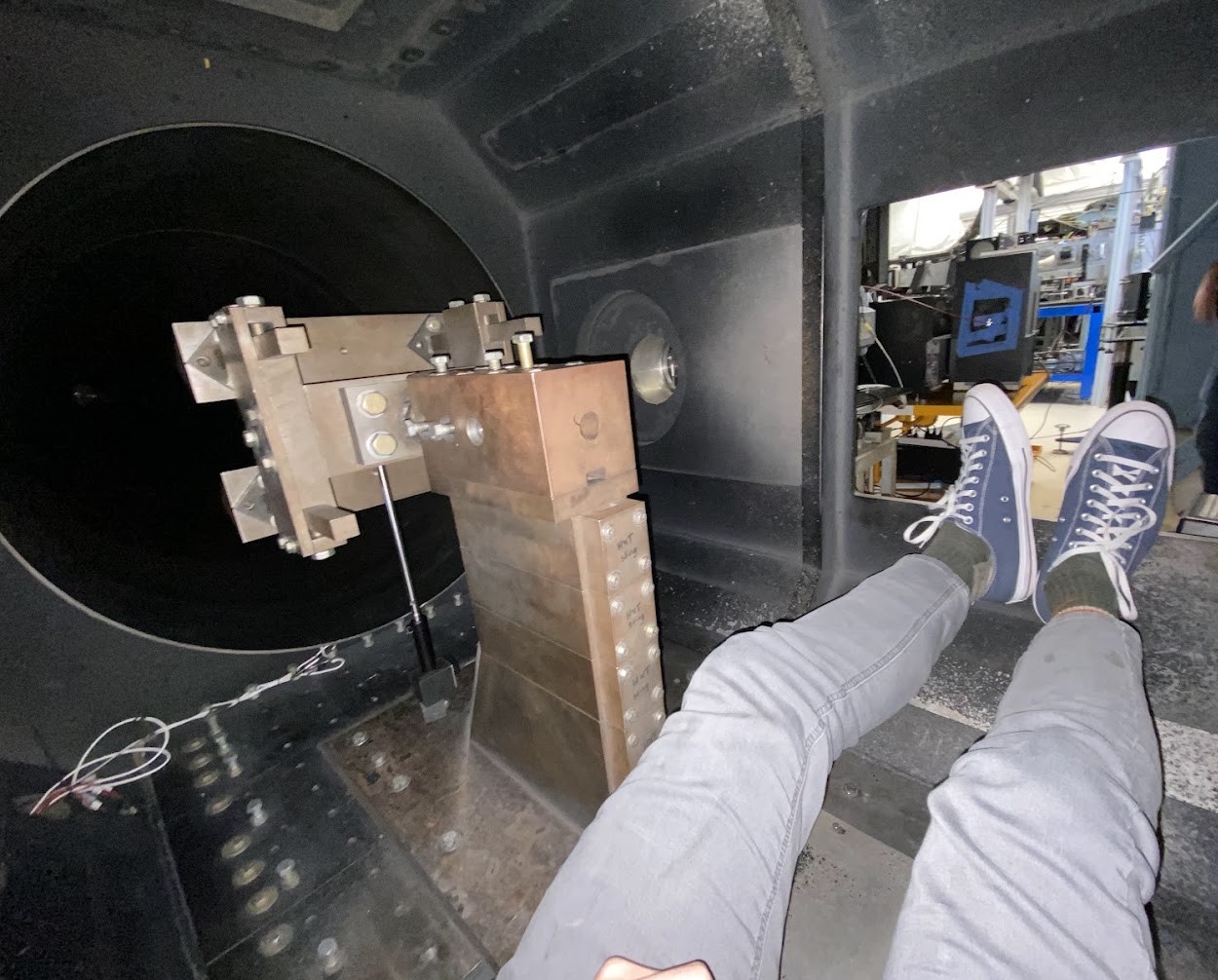
After developing a laser diagnostic in the lab, the next step is to deploy it for an application that people actually care about. (No one is interested in using the $1 million laser system to measure ambient temperature in the lab.) That’s when I rally the troops to push the 10-foot long, 1 kHz laser system down to HXT and we try to measure temperature in the 1 ms test window. I’ve had one campaign where I unsuccessfully tried to measure vibrational temperature behind Mach Stem model. In another campaign, we successfully measured rotational temperature in freestream and the boundary layer of an Ogive model.
Last spring, another grad student and I used the 60 kHz CARS system to measure temperatures in the Ludwieg tube. (We were using that new, top-secret CARS technique that’s cooking.) We simultaneously collected Schlieren data, a technique that visualizes density gradients in the flow by detecting how light bends as it passes through regions of different density. This allows you to see shock structures that would otherwise be completely invisible. Over 35 runs were completed to perform parametric studies of the rotational temperature at various distances in front of the models, where the flow is most heavily influenced by their presence.
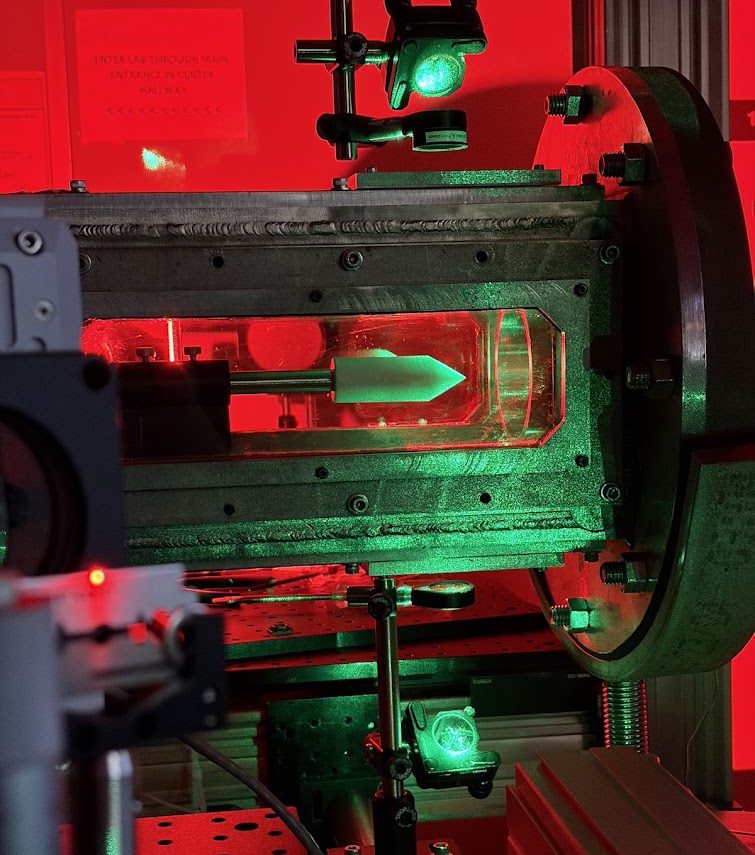
FLEET (Femtosecond Laser Electronic Excitation Tagging) works by using a femtosecond laser to tag nitrogen molecules in the flow and imaging how those molecules move over time to calculate velocity. I have performed 1 kHz FLEET measurements in both BLAM and HXT. The work in BLAM was using FLEET to characterize the tunnel. “Characterizing the tunnel” is a term for measuring what the tunnel actually does and is the first step performed when a new facility is operational. Essentially we are using FLEET to measure the velocity inside the tunnel section at different locations. This information helps to validate that the flow inside the tunnel is behaving the way that it was designed. In HXT, I’ve set up FLEET to perform boundary layer measurements of various models. A boundary layer measurement is essentially trying to determine the flow dynamics in the vicinity of the model. FLEET is used to visualize and quantify the transition from hypersonic flow to zero velocity at the model.
CARS Measurements in Plasmas
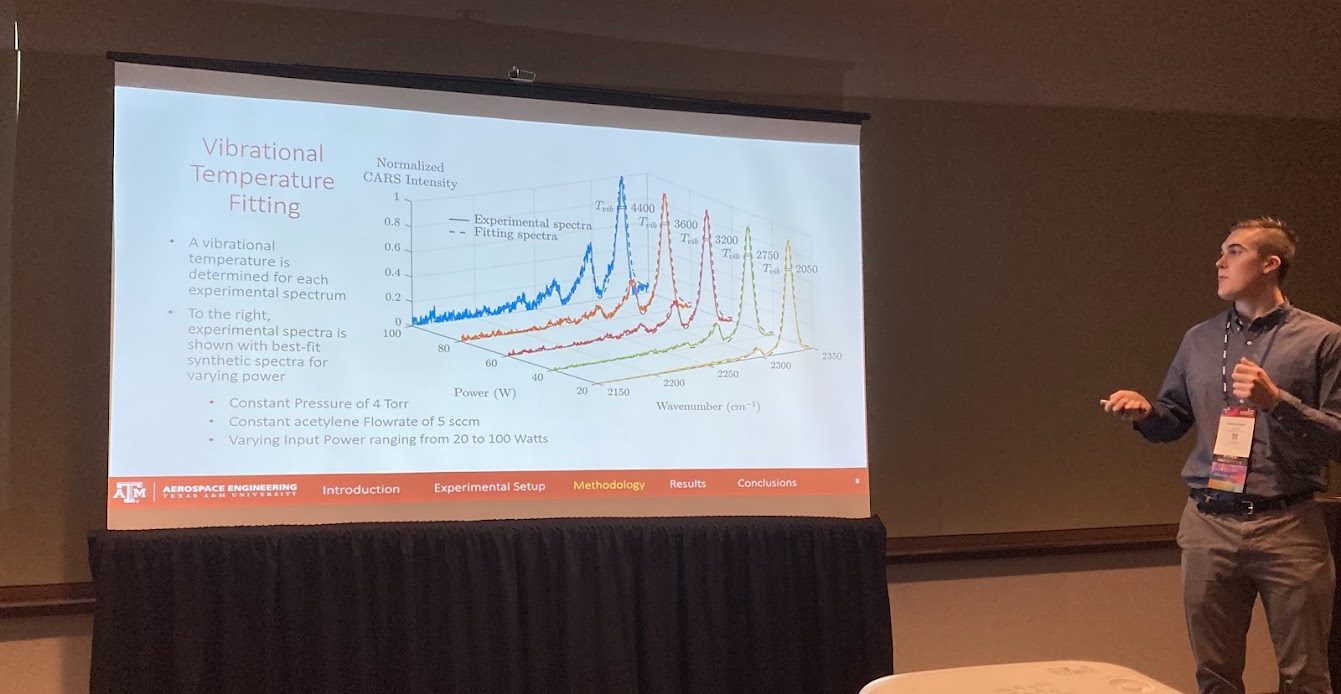
The first plasma project to discuss was a collaboration with researchers from UC Riverside. They brought in a “plasma reactor” that is essentially just a discharge tube that uses plasma to convert acetylene into carbon nanoparticles. The goal of the project was to study plasma at different operating conditions. We were able to successfully use CARS to measure vibrational temperature and gas temperature. Additional experiments at matched conditions allowed us to see how temperature influenced the yield (amount produced) of carbon nanoparticles which can be used to create carbon nanotubes.
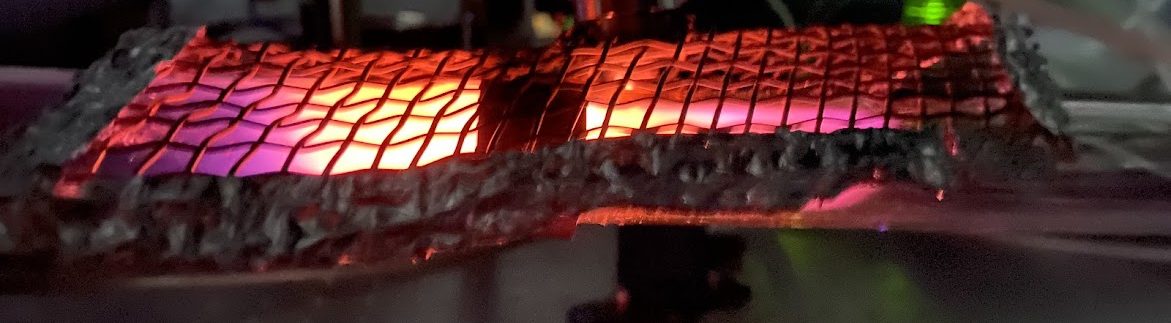
The second plasma project used a similar plasma cell that was designed to study more fundamental aspects of plasma physics. In this experiment we were able to measure two different gas mixtures (pure N2 and air) across varied pressure and input powers. The interesting finding was that the presence of oxygen resulted in a greater amount of electronic energy being transferred into rotational modes rather than vibrational. As far as I know, this has been the best experimental confirmation of an effect that was mostly only theorized.
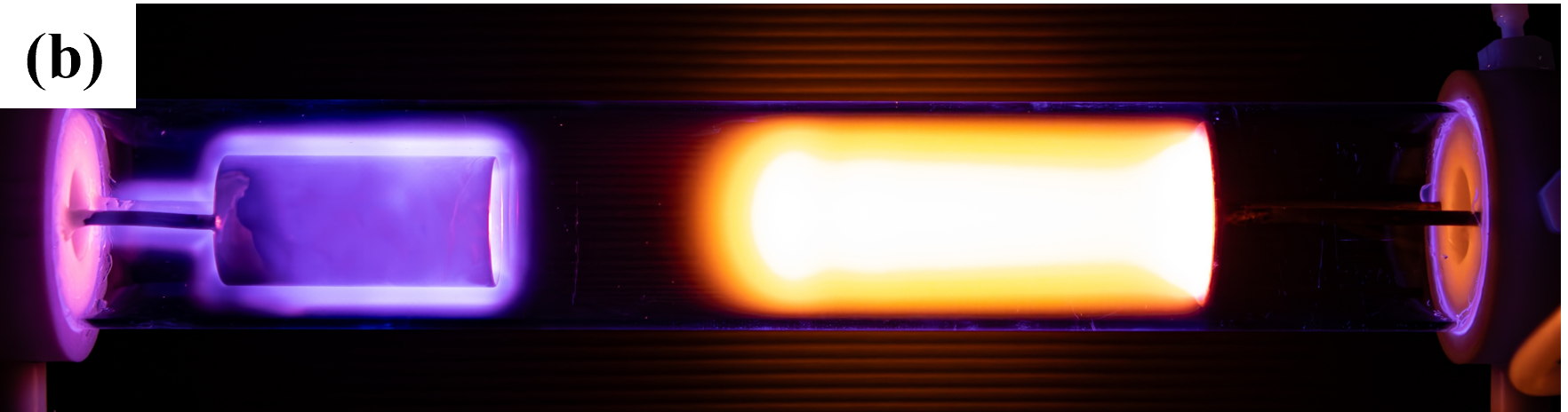
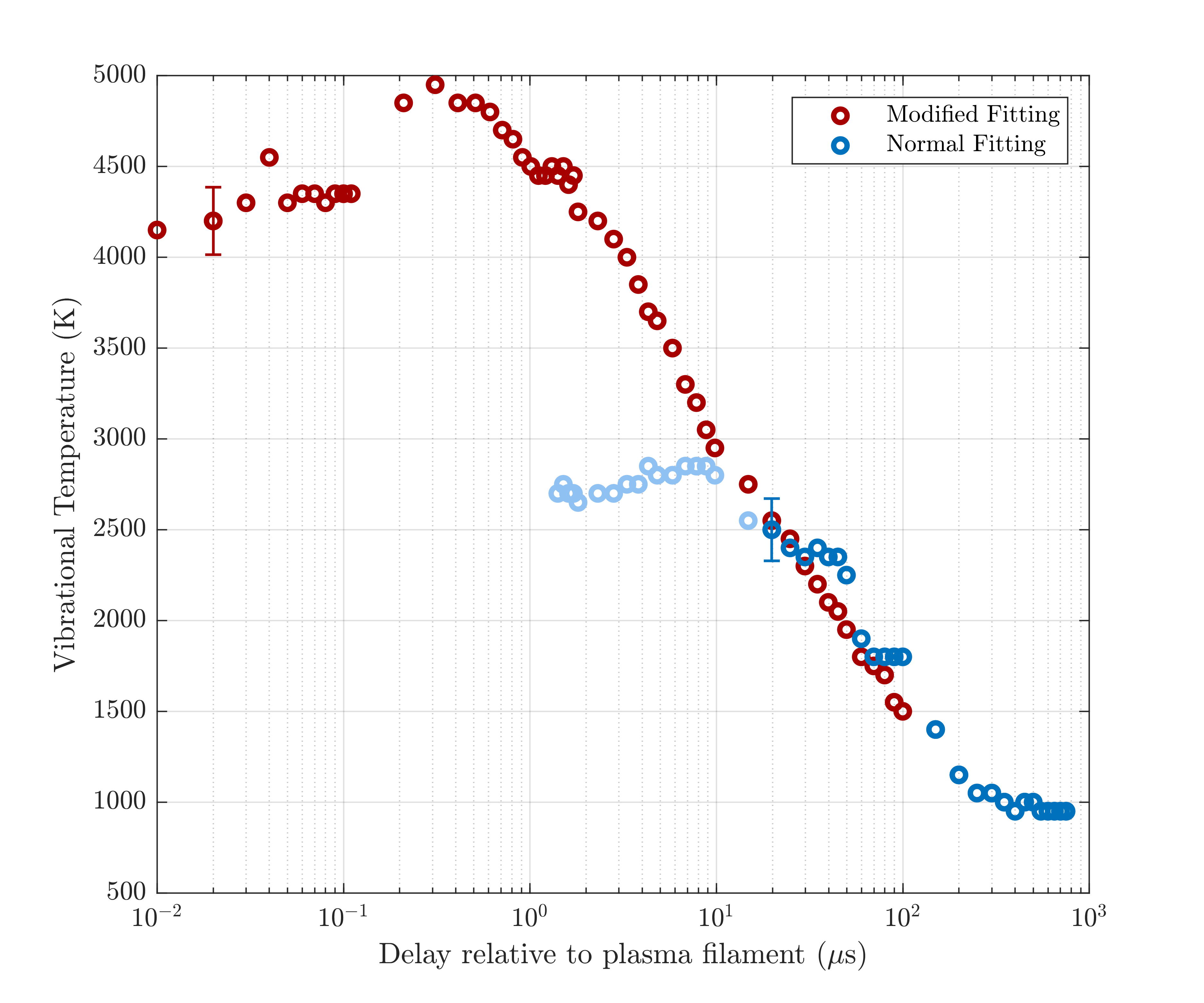
The third plasma project involved studying fs filaments which are a bright line of light that can be generated by focusing a fs laser. Imagine this as a miniature, non-solid lightsaber that is pulsing in time. We used a separate CARS system to measure temperature inside of that filament. The end result of this project was mapping out the evolution of vibrational and rotational temperature over the lifetime of each fs pulse.
Conclusion
Hopefully this will give you a better picture of what I actually spend my time on. I’m sure that I used too much jargon for some people to understand this. Those in my research field are probably cringing at my clumsy simplifications. If you haven’t realized yet, I really enjoy this.


Leave a Reply